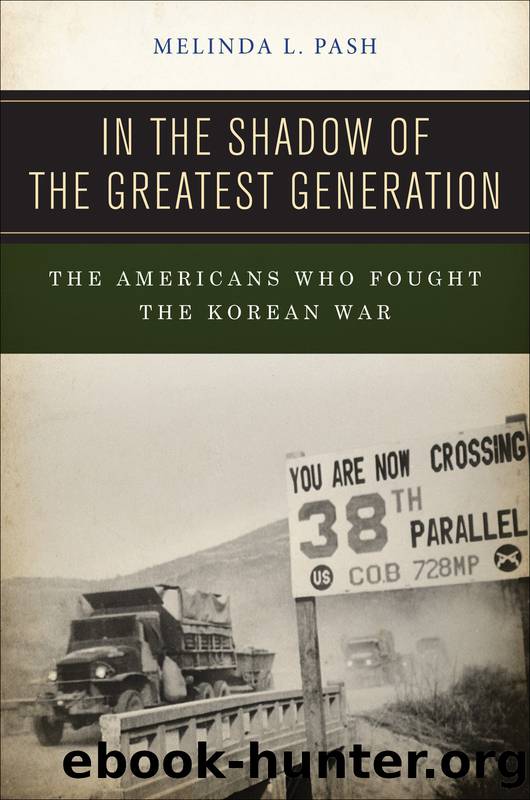
In the Shadow of the Greatest Generation by Melinda L. Pash
Author:Melinda L. Pash
Language: eng
Format: epub
ISBN: 9780814767696
Publisher: New York University Press
Published: 2012-08-15T00:00:00+00:00
Denied burial in Sioux City, Iowa, because of his Winnebago ancestry, fallen Sergeant First Class John Rice is laid to rest at Arlington National Cemetery with full military honors. Riceâs mother, Mrs. Samie Davis, can be seen in the wheelchair in the front row. U.S. Signal Corps, courtesy of the Harry S. Truman Library (photograph no. 2005-12).
Confronted with Jim Crow segregation and bigotry, the unsavory hallmarks of American life outside of the U.S. military, many nonwhite returnees felt confused, even angry. They had marched to war armed with the belief that their wartime service would result in a âlarger measure of freedom, dignity, and opportunity for our loved ones at home.â That had not happened and, like the wife of an Army veteran denied service at several California restaurants, they wondered why they had fought at all and â[w]here is the country that he fought for?â114 Others asked, âWho was my worst enemy, really?â115 Were communists abroad as bad as racists at home? White veterans, possessing intimate friendships across the color line from their service in the Army or Marine Corps, also felt âdeeply perplexed about the racial discriminationâ leveled against their comrades.116 But what would they do about it?
In light of the activism and controversy stirred up by the Vietnam War and veterans of that conflict, historians have tended to view Korean War veterans as passive, easily accepting the status quo and peacefully melting back into society after returning from the war. Indeed, raised during the Great Depression and World War II, most veterans of Korea early learned and internalized the lesson that no matter the circumstances, one had no other choice but to uncomplainingly forget personal preferences and get on with the tasks at hand. The culture of conformity that rose with the Soviet threat in the years after World War II reinforced the inclination to subvert oneâs own desires for the security of the country. Consequently, Korean War veterans, whatever their ideas on the matter, did not launch any great crusades to win equal civil rights for Americans of all colors.
However, Korean War veterans individually protested Jim Crowism and contributed to the quest for social justice in invaluable ways. One black noncommissioned officer, frustrated at having to move to the back of the bus when it left the base, made a point while on post of sitting âright behind the driver, just to watch the cracker burn up.â117 Delbert White, faced with discrimination while looking for work, decided to do something about it and filed a complaint with a government agency.118 During the Vietnam War, Clarence Adams, one of the American Korean War POWs who originally refused repatriation and went to the Peopleâs Republic of China, made radio broadcasts telling African Americans, âIf you are going to fight, you need to go home and fight for your own cause. Youâre being wasted for a cause that isnât even yours.â119 Others joined the NAACP and contributed to its âFreedom Fundâ to âhelp improve our democracy.â120 So many blacks
Download
This site does not store any files on its server. We only index and link to content provided by other sites. Please contact the content providers to delete copyright contents if any and email us, we'll remove relevant links or contents immediately.
| Anthropology | Archaeology |
| Philosophy | Politics & Government |
| Social Sciences | Sociology |
| Women's Studies |
Cecilia; Or, Memoirs of an Heiress — Volume 1 by Fanny Burney(32562)
The Great Music City by Andrea Baker(32023)
Cecilia; Or, Memoirs of an Heiress — Volume 2 by Fanny Burney(31959)
Cecilia; Or, Memoirs of an Heiress — Volume 3 by Fanny Burney(31945)
We're Going to Need More Wine by Gabrielle Union(19053)
All the Missing Girls by Megan Miranda(16052)
Pimp by Iceberg Slim(14522)
For the Love of Europe by Rick Steves(14174)
Bombshells: Glamour Girls of a Lifetime by Sullivan Steve(14081)
Norse Mythology by Gaiman Neil(13379)
Talking to Strangers by Malcolm Gladwell(13376)
Fifty Shades Freed by E L James(13247)
Mindhunter: Inside the FBI's Elite Serial Crime Unit by John E. Douglas & Mark Olshaker(9349)
Crazy Rich Asians by Kevin Kwan(9297)
The Lost Art of Listening by Michael P. Nichols(7509)
Enlightenment Now: The Case for Reason, Science, Humanism, and Progress by Steven Pinker(7316)
The Four Agreements by Don Miguel Ruiz(6770)
Bad Blood by John Carreyrou(6626)
Weapons of Math Destruction by Cathy O'Neil(6284)
